Sunday, 23 June 2013

Other interesting Exhibitions and artists from Hopkinson Cundy, Auckland

Recently I have been focusing on other ways to install my work, looking specifically at presenting my work in a way that highlights their materiality. I am now trialling installations that focus less on the aesthetics of delicate craft and more on experimenting with simple everyday materials that activate each other and the surroudning space. 

     Dane Mitchell, Daniel Malone, Mikala Dwyer, Peter Robinson
Light Sweet Crude
12 Apr - 11 May 2013


Mikala Dwyer
Methylated Spiritual, 2012
mixed media
 
Dane Mitchell
Spectral Readings (Liverpool), 2012
blown glass, spoken word, found display table

    Ruth Buchanan, On or within a scenario, 31 Jan - 02 Mar 2013

Ruth Buchanan
On or within a scenario, 2013
 
Ruth Buchanan
On or within a scenario, 2013

 
Ruth Buchanan
The History of a Room, 2012
painted air-dried clay, paper, mirror, carpet, customised table


      Kate Newby, Lauren Winstone, Nicholas Mangan, Nicola Farquhar, Sam Rountree Williams
Dugout
05 Apr - 05 May 2012

Sam Rountree Williams
Isthmus, 2012
shells, spray enamel and gesso on canvas

 
Kate Newby
Loads of difficult, 2011
set of 18 handmade ceramic sticks on custom bench

Lauren Winstone
No possible wholes, 2012
stoneware
 

       Daniel Malone
Epicurios for an Other CV or, The Geophagy of Europe & its Autochthonous Peoples or, A Communist Kiosk in a Common Market
08 Feb - 10 Mar 2012

Daniel Malone
A Communist Kisok in a Common Market, 2012
Specifically looking at the work coming down the wall - alternative installation - how the material can be read in relation to the wall and the floor.

Daniel Malone
A Communist Kisok in a Common Market, 2012


Daniel Malone
Floor Painting (Swedish Table), 2012
mixed media
Material support and thinking about how the work is read - working with the strengths of the materials.

Daniel Malone
                                          A Communist Kisok in a Common Market, 2012
                                              installation view: Hopkinson Cundy, Auckland
     Alex Vivian
An oversized jacket. Jeans, that fit.
02 Sep - 01 Oct 2011


Alex Vivian
An oversized jacket. Jeans, that fit., 2011
installation view

Alex Vivian
Classic vases with gesture (of body form), 2011
glass vases, socks

Alex Vivian
Only a form. Not human or a being… Male? (A structure?) Merely stuffing in glass to help it "sit" right., 2011
clothing, concealed grease stains, glass




After Talk Week

Points from my critique that I have decided to further investigate:

 - Sense of temporality and fragility – I am still interested in keeping the temporality of my installations so that there is a sense of experimentation and a temporary response to the occupied space.
 -  Opening up an awareness for the viewer of past markings and trances in the space.
 - Not set or permanent
 - Drawing base – continuous line
 - Improvisation – making decisions as I go along through the making process
 - Rhythm in the material
 - Contemporary activists group – filling cracks with bright wool – responding to the space –using colour, line, circular shapes and everyday materials to make connections the surrounding space.

Kate Newby:


         Looking at other ways to install my work: try different supports to alter the reading of the material or focus more on the materiality rather than its reference to its everyday use. Exploring the ways in which these everyday materials can talk to each other by being selective in the number of objects I present and how they sit in the space in relation to one another and the environment.

          Platforms: fragility, escaping rug reference
          Floor: responding to markings or other objects found in the space, heavier materials
         Wall: hanging, look at colour and how the material will be read.
         CONSTRAINTS: placing constraints on my process/ interaction with the material to further understand their materiality   (strength), and what I can do with them to inform the reader of my selection of materials and their activation of the space.

 
Kate Newby
What a day., 2013
installation view: Hopkinson Cundy, Auckland


Kate Newby
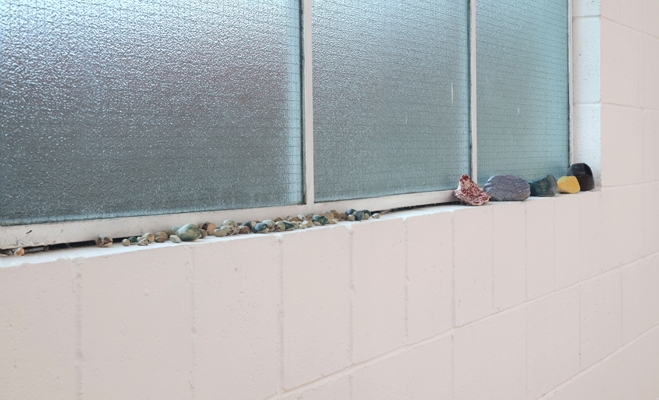
I'm finally having fun on this table, 2013
set of 10 ceramic rocks (stoneware, porcelain, glaze)


Kate Newby
It's an option not to feel bad about it, 2013
set of 8 ceramic bells (stoneware, porcelain, terracotta glaze)

Developing my ideas: New material experiments and installations..

Everyday materials, colours rope responding to the space


In studio installations:

"Untitled," 2013, found materials (old woolen garments, coloured wool, string, tape, cords)

Close Ups:


 - Colour combinations – colours that work, create interesting relationships, contrast each other, range of intensity to highlight chosen markings in the space
 - Being more selective in the materials that I choose to focus on specific relationships between each addition and the surrounding space.
 - In this installation I think I can afford to take away some of the elements as it is too currently too loaded.

 - I also want to be selective in the already established markings of the space that I choose to highlight. I am doing this by involving them in the installation using my selected materials and also removing other markings with turps to draw attention to my interaction with these given characteristics of the installation space. 


Final installation for talk week:

photos:

Op shop material, colour inspinspiration and combinations

"Untitled," 2013, Op shop and found wool (garments)
Close ups:
exploring the contrast of bold bright colours against the textured strands of found material.
Looking at layers and colour combinations

Detailed, close up video of final installation:


Thursday, 20 June 2013

Talk week:


After talk week: Response from critique group

AESTHETIC OR ANTI AESTHETIC??..

·         My work was looking at similar questions to Samantha’s work – labour, similar materials, colour choices (intentional/ intuitive selection) and colour relationships), found materials

·         Reference to handmade doilies

·         Sense of temporality and fragility

·         Not set or permanent

·         Precious quality to work

·         Value and quality

·         Drawing base – continuous line

·         Improvisation – making decisions as I go along through the making process

·         What was there to work with...not cutting or changing the material

·         Rhythm of the material

·         Ritualised performance – continuous making of the circles – if I decide to keep this process temporary

·         Strip the colour right down? Or keep it intense and large variety

·         Rag rugs – tradition – clothes rolled up and turned into a rug.

·         Look more closely at my relationship to craft  - craft in contemporary art (chicks on speed)


Artist:

·         Polly Apfelbaum

·         Kate Newby – Hopkinson Cundy

·         Chicks on Speed

·         Rosemary Trockle

·         Contemporary activists group – filling cracks with bright wool

Considering other installations


·         My choice of floor: unsure about the wall and the installation sitting in its shadow..it seems to be pushed up into the corner, situational

·         On the floor it references a rug due to its placement and the materials used – try different supports to alter the reading of the material or focus more on the materiality rather than its reference to its everyday use.

Other options:

·         Platforms? Trialling other supports

·         Materiality: On the platform I could choose to present wool that has a softer, more delicate, floating presence

Floor circle:  denser, heavier/ weighty existence – rope, heavy colour, hose, and extension cords

Hanging on the wall/entwined in something to keep stable – wire...winding wool or rope, chains, cord..

·         Have it wondering though the space

·         Relating to different things in the space (the floor, paint marks, dents or cable attachments in the ground

·         Decisions on intensity – if I include lots of colour and mass – when is it enough – less is more or more is more?


·         Breaking up the circles – woven together – separate or layered?

·         Isolating two different circles – exploring different ways in which the materials can talk to each other  - ie. Dull old rough material, interacting with high quality colourful material.....do I want to go into those ideas...?

·         CONSTRAINTS: placing constraints on my process/ interaction with the material to further understand their materiality (strength), and what I want them to do/ tell the reader
How I incorporate the process of the activity – how important is it in the final reading? Making permanent circles..or temporary? What ideas I decide to highlight using these materials
Biennale


Sachiko Abe: Cut Papers # 13, 2012


Japanese artist Sachiko Abe cuts fine strips of paper for hours on end in her performance series titled Cut Papers. Having first discovered the calming effects of shredding paper over 15 years ago while admitted at an insane asylum, the artist now explores the act's meditative properties as an art form. Abe most recently performed Cut Papers #13 this year at the 18th Biennale of Sydney at Cockatoo Island.
Encircling herself in a fortress of tattered slivers of white paper, Abe says, "The act of cutting is a constant exercise through which I organize and structure my random thoughts." It is through the repetitive, time-consuming process that the artist finds a peaceful state of mind. She goes on to say, "The rhythm of the scissors, the fineness and the length of the paper strip correspond to the process of my thinking, and its effect to the body. While essentially personal, Cut Papers is a necessary practice for me to formulate my relationship to the external world.
"The act defines and redefines the boundary between the self and the other, and helps to recover a meaningful relationship with one another. Complete silence and neutral white space allow the audience to focus purely on the sound of scissors and slight movement of the cut papers. The closed environment also invites the viewer to synchronize with the tide of emotion and contemplation created by the performance."


Interesting website for artists and exploring installation ideas to do with the floor:

http://pinterest.com/cimcnamara/on-the-floor/

Artists and ideas I found interesting:

1) Artist : Elana Herzog

- decaying process
- dematerialisation
- deconstruction, reconstruction
- cheap, tacky discarded household items, carpets and fabrics


2) http://www.lostateminor.com/2011/03/24/yarn-meets-potholes-a-different-kind-of-street-art/

Yarn Meets Potholes: A Different Kind of Street Art

Who doesn’t know them? The cracks in the roads that make driving and walking way less comfortable? Juliana Santacruz Herrera has had the funny idea to turn these unwelcome side effects of ‘nature at play’ into something more pleasant by filling the gaps with bright and colorful strands of yarn. Juliana currently fills potholes in Paris. Although her work might not be for eternity, it surely inspires some Parisian passers by to smile.


Artist: Jan Vorman‘s He uses Lego to fill in holes left from the war in Berlin and does similar installations in other places around the world


3)Tamiko Kawata - safety pins - from ordinary to extraordinary
continuous line, creating an environemtn by hanging the saftey pins, delicate and light presence, a space which denys access

 
 Rain Forest/SUNY 18’x45’x12’ Safety pins 2000

4) Polly Apfelbaum: Polly Apfelbaum’s new installation spreads dyed bits of velvet over the floor of D’Amelio Gallery in Chelsea in New York. We ought to be able to dismiss Apfelbaum’s works as old-fashioned, self-absorbed abstraction, fiddling about with color and form – that’s the world she came out of in the late 1970s. But there’s something about her trademark shift to the floor, and the contingency of her scattered parts, and her links to the history of textiles and crazy-quilting and all kinds of women’s work, that guarantees the continuing freshness of her installations. Somehow, ending up on the floor surrenders the ponderous authority that still clings to pictures on walls – maybe because there’s a sense that we could mess the work up if we wanted to, and yet choose to leave it unstepped on.