Responsive Eye Show at MOMA in1965:
http://www.moma.org/collection/theme.php?theme_id=10139
Term used as an abbreviation of ‘optical art’ to refer to painting and sculpture that exploits the illusions or optical effects of perceptual processes. It was used for the first time by a writer in an unsigned article in Time magazine (23 Oct 1964) and entered common usage to designate, in particular, two-dimensional structures with strong psychophysiological effects. The exhibition, The Responsive Eye, held in 1965 at MOMA, New York, under the direction of William C. Seitz, showed side by side two types of visual solicitations already practised by artists for some time: perceptual ambiguity created by coloured surfaces, then at the fore in the USA, and the coercive suggestion of movement created by lines and patterns in black and white, used abundantly by European artists engaged in Kinetic art. The outstanding Op artists included Victor Vasarely, Bridget Riley, Jesús Soto, Yaacov Agam, Carlos Cruz-Diez, Julio Le Parc and François Morellet.
The origins of Op art can be traced from both the art-historical tradition and from popular art, in particular from ornament, trompe l’oeil and anamorphosis. The antecedents of Op art in terms of graphic effects and coloured interaction may be found in the works of the Post-Impressionists, Futurists, Constructivists, Dadaists and above all in the artistic and didactic statements of the masters of the Bauhaus. Links with psychological research can also be established, in particular with Gestalt theory and with discoveries in psychophysiology. Op artists thus managed to exploit various phenomena: the after-image and consecutive movement; line interference; the effect of dazzle; ambiguous figures and reversible perspective; successive colour contrasts and chromatic vibration; and in three-dimensional works different viewpoints and the superimposition of elements in space.
Group of artists included in this show:
Victor Vasarely, Bridget Riley, Jesús Soto, Yaacov Agam, Carlos Cruz-Diez, Julio Le Parc and François Morellet
1) Victor Vasarely:
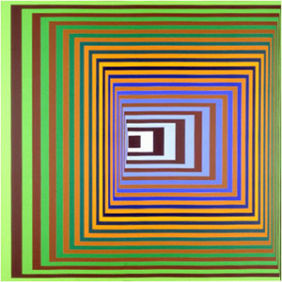
Vasarely began working with graphic elements on the surface plane before superimposing them on transparent materials in order to obtain subtle visual effects.
Victor Vasarely - 1960
Vonal-Stri - Victor Vasarely 1975 Acrylic on canvas 200x200cm
2) Bridget Riley:
Riley obtained strong black and white effects, for example in Blaze 2 (1963; Belfast, A.C. N. Ireland). Geometric units such as squares, triangles and circles were depicted in such ways that their distortions set up a definite rhythm. The optical spasms that result from this often allude to energy and to psychological phenomena, perhaps emanating from the unconscious. Later Riley moved away from the sharp contrasts of black and white, which created a fluctuating or ‘active’ space and strong light effects, towards tonal variation and eventually to colour contrast.
Bridget Riley, "Fragments" 1965
Blaze 1964
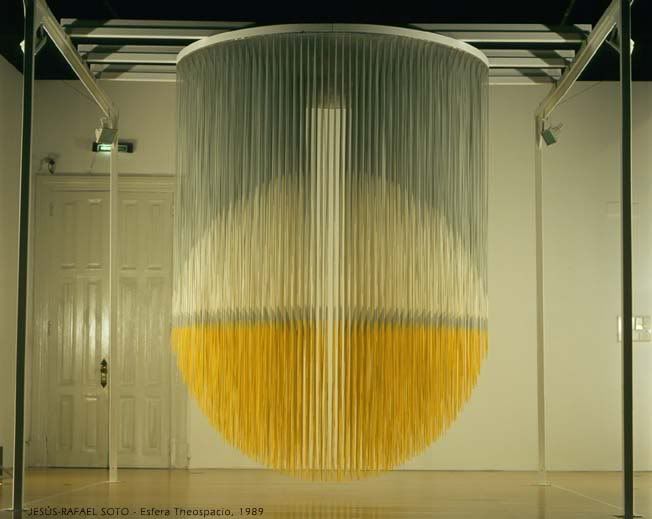
3) Jesús Soto:Soto’s research into optical vibrancy began in 1952 when he experimented with various chromatic and luminous elements distributed over the surface before he arrived at the moiré effect, which he favoured as a means of making solid objects such as wire structures appear to dissolve.
4)Yaacov Agam: Agam similarly constructed works that depended on the spectators’ participation. He used musical terminology such as ‘contrapuntal’ and ‘polyphonic’ when naming his works. In this way he was trying to reach beyond the time-scale implicit in traditional music, regarding mere duration as infinitely less rich than the dynamic, irreversible and unforeseen quality of time that is involved in his transformable paintings.
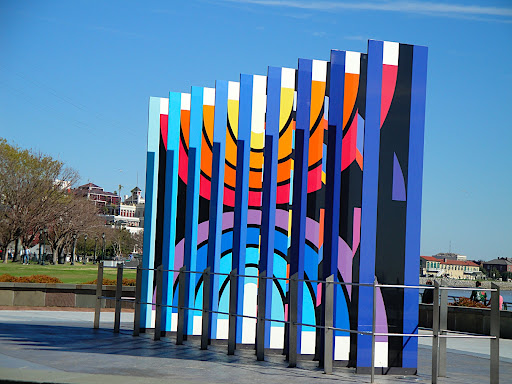
looking at layers, transparency, pattern
LOOKING AT THE USE OF A CORRUGATED SURFACE!
distorting the surface and messing with the viewer's perception
5) Carlos Cruz-Diez: colour in space and time....
In his Physichromies (from 1959) Cruz-Diez applied a theory of additive colours, combining a technique of regularly spaced card strips with earlier experiments with colour. He achieved a subtle interaction between the very intense reflections from the surfaces turned towards the spectator and the effects of expanding colour recorded upon the surfaces adjacent to the pigment. This allowed him in later environmental works to undertake an analysis of colour in confined spaces in order to induce successive situations that are themselves liable to give rise to chromatic events
6) Julio Le Parc:Le Parc and Morellet already had the development of a new visual situation as an ultimate objective; their interest lay exclusively in the object/eye relationship rather than in the object considered for its intrinsic plastic properties....etc
7) François Morellet.