Thursday, 31 October 2013

New "Eye-Teaser"

I have been quite against making anything to much like an object, but I am interested to see how I can place this work in the space. It could possible act as a support for another work, or alter the experience of the joining of the white studio wall. I am drawn to the shiny appearance of the ribbon and how, when placed under the studio lights, it can reflect colour onto the wall.

Supporting another work eg. "Daze," a black and white wool spiral made on a red plastic plate.


Tuesday, 29 October 2013

New addition to my series of "Eye-teasers."

 
Thinking about titles: touch, stroke, brush, caress, cushy...
"Untitled," October, Fur rug, finger line drawing.

 
I have been introducing a variety of materials to include a range of different sensual experiences in the viewer. By simply drawing the continuous line fo the swirl I want to draw the viewer's attenetion to its material qualities and feel drawn to its soft texture that can easily be manipulated.

Saturday, 26 October 2013

Looking closer at the art practise of Bridget Riley:


Manser, Jose. "Design Museum." RSA Journal, Vol 137, No. 5398 (1989): 675-676. Accessed October 23, 2013.
http://www.jstor.org.ezproxy.aut.ac.nz/stable/pdfplus/41375011.pdf?&acceptTC=true&jpdConfirm=true


1) She has chosen incomparable paintings. All are rich in colour and detail: most touched or dominated by blue, a colour which seems glorious to Riley. She does not point out that narrative painting, as opposed to abstract, allows the artist to portray many observations and differing sensibilities at once.


Bridget Riley guides the onlooker through the static representations on canvas pointing out the movement which enlivens the imagery and supports the colour

Bridget Riley implores us to look closely. In my view it would follow that abstract art provides less to look at, less to feed our humanity, even if it has its own wonders. Who could not wonder at Riley's own ability to arrange bands of colour so that the flat canvas appears to project movement which neither begins nor ends, but is in motion when first seen and is active when left behind?

She chose abstraction because she found it 'sensual'. She rejects pre-planning as 'it gets in the way', maintaining that all decisions are taken on the evidence of her eyes: 'there is no right or wrong, only a judgement for the health of the work I am doing'.
 
Bridget Riley, "Rock"


Thursday, 24 October 2013

Recent works:

I have searched around and found this material that as the previous articles said...optical imagery is all around us in the everyday. This material struck me with its intense colour relationship between the black and white, and how they almost fizz against each other, making it uncomfortable to look at for too long. I am planning to intensify this sensation by hanging the material over corrugated plastic to warp the lines into genlte curves, greatly increasing the optical sensation and putting the viewer into a visually uncomfortable situation.


 Intorducing new textures and layers that will bring about new sensations in the viewer as they experience this eye teasing, sense awakening environement.
I have been thinking a lot about the overall effect of a moving work in my space and I will try it with the installation. I have a feeling that a work with actual movement may detract from the other works so I will have to trial it before I rule it out.


Working over corrugated plastic to explore its materiality again...I have specifically chosen cooler colours to slightly calm the viewers senses from the intense experience of this installation.


workign with black and white to give the viewer the sense of alluding to a faster movement and accelleration of the continuous line....."Black and white works oscillate between surface and infinity, while the use of color defines something in between." (from previous post)

The addition of the pink fluff was intended to soften the defined lines of the circle. I want play with a range of the viewer's senses, lighten the image and give the viewer the soft sense of wanting to touch it and experience the work intimately.


Sunday, 20 October 2013

New interesting blog;

http://joannemattera.blogspot.co.nz/2008/09/centering.html


VIDEOS:

Here is a list of interesting videos I have been watching about abstract, optical art...including Bridget Riley and  Claude Tousignant:

http://www.youtube.com/playlist?list=PL917F979464E08C36

some specific ones that I found interesting:

Interview about the exhibition: Claude Tousignant, a Retrospective:

http://www.youtube.com/watch?v=Fiavxyyjd2I&list=PL917F979464E08C36&index=33

Jesús Rafael Soto at Gamec in Bergamo:

http://www.youtube.com/watch?v=qJ4dFYIT3s4&list=PL917F979464E08C36&index=13

Higher and Higher Vibrations:
http://www.youtube.com/watch?v=GLJFZJnJaW8&list=PL917F979464E08C36&index=10


All of these videos have contributed to my understading of what I want to accomplish with my final years installation

- focus on movement and intensity of pattern through continuous line and colour
- small distortions of pattern and colour through using a range of supports - corrugated plastic, making a distorted circle on a bean bag.
 - I want each work to be playful, and bring about a slightly different sensation so that together they create an environment where the viewer is confronted with a range of sensations and mesmerising imagery.

Responsive Eye Show at MOMA in1965:


http://www.moma.org/collection/theme.php?theme_id=10139


Term used as an abbreviation of ‘optical art’ to refer to painting and sculpture that exploits the illusions or optical effects of perceptual processes. It was used for the first time by a writer in an unsigned article in Time magazine (23 Oct 1964) and entered common usage to designate, in particular, two-dimensional structures with strong psychophysiological effects. The exhibition, The Responsive Eye, held in 1965 at MOMA, New York, under the direction of William C. Seitz, showed side by side two types of visual solicitations already practised by artists for some time: perceptual ambiguity created by coloured surfaces, then at the fore in the USA, and the coercive suggestion of movement created by lines and patterns in black and white, used abundantly by European artists engaged in Kinetic art. The outstanding Op artists included Victor Vasarely, Bridget Riley, Jesús Soto, Yaacov Agam, Carlos Cruz-Diez, Julio Le Parc and François Morellet.
The origins of Op art can be traced from both the art-historical tradition and from popular art, in particular from ornament, trompe l’oeil and anamorphosis. The antecedents of Op art in terms of graphic effects and coloured interaction may be found in the works of the Post-Impressionists, Futurists, Constructivists, Dadaists and above all in the artistic and didactic statements of the masters of the Bauhaus. Links with psychological research can also be established, in particular with Gestalt theory and with discoveries in psychophysiology. Op artists thus managed to exploit various phenomena: the after-image and consecutive movement; line interference; the effect of dazzle; ambiguous figures and reversible perspective; successive colour contrasts and chromatic vibration; and in three-dimensional works different viewpoints and the superimposition of elements in space.

Group of artists included in this show:
 Victor Vasarely, Bridget Riley, Jesús Soto, Yaacov Agam, Carlos Cruz-Diez, Julio Le Parc and François Morellet
1) Victor Vasarely:
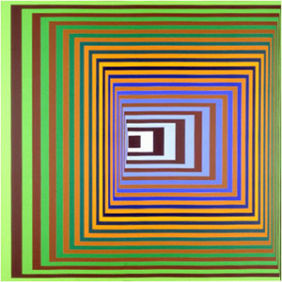
Vasarely began working with graphic elements on the surface plane before superimposing them on transparent materials in order to obtain subtle visual effects. 

Riu-Kiu-C


                                                              Vonal-Stri - Victor Vasarely 1975 Acrylic on canvas 200x200cm
2) Bridget Riley:
 Riley obtained strong black and white effects, for example in Blaze 2 (1963; Belfast, A.C. N. Ireland). Geometric units such as squares, triangles and circles were depicted in such ways that their distortions set up a definite rhythm. The optical spasms that result from this often allude to energy and to psychological phenomena, perhaps emanating from the unconscious. Later Riley moved away from the sharp contrasts of black and white, which created a fluctuating or ‘active’ space and strong light effects, towards tonal variation and eventually to colour contrast.
                                                            Bridget Riley, "Fragments" 1965

                                                                                                    Blaze 1964
Untitled 1964
                                                                  Fragment 1/7 1965

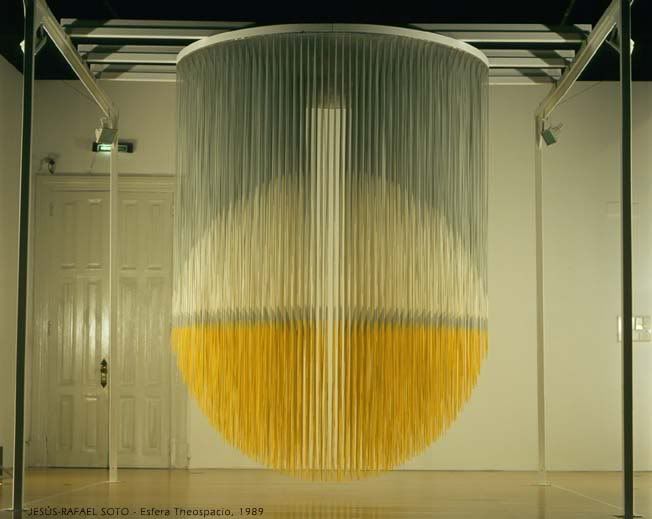
3) Jesús Soto:Soto’s research into optical vibrancy began in 1952 when he experimented with various chromatic and luminous elements distributed over the surface before he arrived at the moiré effect, which he favoured as a means of making solid objects such as wire structures appear to dissolve.


4)Yaacov Agam:  Agam similarly constructed works that depended on the spectators’ participation. He used musical terminology such as ‘contrapuntal’ and ‘polyphonic’ when naming his works. In this way he was trying to reach beyond the time-scale implicit in traditional music, regarding mere duration as infinitely less rich than the dynamic, irreversible and unforeseen quality of time that is involved in his transformable paintings. 
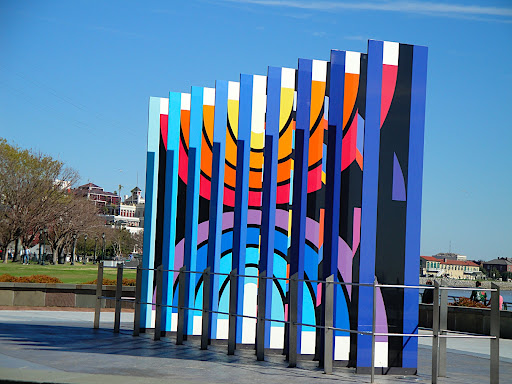

looking at layers, transparency, pattern

LOOKING AT THE USE OF A CORRUGATED SURFACE!
distorting the surface and messing with the viewer's perception


5) Carlos Cruz-Diez: colour in space and time....
In his Physichromies (from 1959) Cruz-Diez applied a theory of additive colours, combining a technique of regularly spaced card strips with earlier experiments with colour. He achieved a subtle interaction between the very intense reflections from the surfaces turned towards the spectator and the effects of expanding colour recorded upon the surfaces adjacent to the pigment. This allowed him in later environmental works to undertake an analysis of colour in confined spaces in order to induce successive situations that are themselves liable to give rise to chromatic events


6) Julio Le Parc:Le Parc and Morellet already had the development of a new visual situation as an ultimate objective; their interest lay exclusively in the object/eye relationship rather than in the object considered for its intrinsic plastic properties....etc


7) François Morellet.