Thursday, 4 October 2012

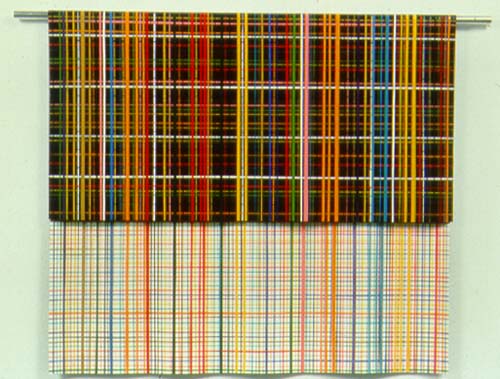
Tester works (for nylon and frames)


  Ideas I am pushing and working with

 - Line, grids - have that reference to weaving and the nylon rplacing the canvas.
 - layering (push and pull, backgroudn and forground)
 - colour - colours that stand out and lightercolours that are subtle and draw the viewer in.
 - materiality - simply looking at the tension created in the fragile lines of bnylon pulled aorud the frame

 In order to focus on the elegance and beauty of these fine colourful lines nylon I feel that the white frames work best as they blend into the wall. I also want to experiment with the intensity of the layering (almost creating a canvas support out of nylon). I want to make some frames that don't have the the outer ridge so that the viewer can focus on the tension of the nylon..or I may leave them as they create and interesting gap betweent he frame and the nylon and create a subtle shadow across the frame.
 
 Yr 2 Show


The year two show was held in a church on Khyber Pass and included approximately 15 yr 2 students from painting, photography and sculpture.
I was only able to set up and attend opening night which was very successful. I found that even though we had a very short space of time to put this exhibition together we all compromised with each other and discussed spots for our work. Each student brought their own wirk and ideas into the space and I found that it tied the space together as some responded tot he space and others works complimented each other.
For me I was interested in creating very delicate installations that appeared fragile and subtle. I then wanted to introduce an unexpected element witht he intense vibrant neon yellow circle to work against that subtlty.
Near the entrance I hung a work from my 'Captured' series in between the two doors. I found that it had a subtle relation to Devon's video works based around the beauty of nature. I also chose to hang this work as I found the leaves brought in the wood from the walls and floor of the beautiful church. This installation hung delicately and blew in the presence of any breeze. Josie also placed her quiet breathing installation beneath my work which I felt enhnced the delicacy of the work as it moved.

I placed my work with rainbow strands of nylon embedded in the glue sheet in the frame of a side door. I found that hanging it from the nylon strands would emphasise the fragility of the installation and have it suspended inforund of the wall to see the semi translucency of the PVA glue.

I am now interested in moving onto more elegant works, still focusing on nylon but taking it away form the experimental/gluggyness of the PVA glue and bringing out the beautiful tension created between layers of nylon.


"Captured" (one form a series of 3)


Wednesday, 3 October 2012

New artist and ideas:

This is a rough idea of one of my new ideas to have nylon strands glued to a linen canvas. I want to work with the grid and elemnts of the weaving (which will relate back to the linen which supports the imagery). I will try this with PVA glue and nylon on a linen canvas, building up different layers, textures, colours and patterns of nylon.

Helene Appel:

Chopping Board - Chopping Board Oil on canvas 30x45 cm
 
Helene Appel, “Netz,” 2010. Acryl, oil, aquarell on canvas 192 x 365 cm
 
Helene Appel, Leek, oil on linen, 72cm x 118cm, 2009
 
Similarly, Helene Appel is not interested in regarding an object as mere training ground for a painter’s technical capabilities. Although Appel is clearly capable, she is mainly dedicated to painting the object in front of her. The raw linen becomes the background. It has to suffice since what matters is the dissected leek. Everything else would be too much and distracting so she decides to loose herself in the object instead of the paint she applies. It is mark-making nonetheless, but with a higher degree of control.
 
Like Helene I am more interested in the nylon patterns I want to creat on the linen surface. Even though th3e weaving and grids referenc the make up of the support I want to get lost in the patterns, colour combinantions and merging of colours created through my pattern making.
 
In the enxt two weeks I am going to really explore these two paths, nylon on linen backgorunds and nylon simply supported by a frame. I feel that both these options escape the experimental qualities of the gloopy PVA glue and focus more on the delicacy and elegance of the patterns made from thin strand sof coloured nylon.
Next plans / new interesting and inspiring artists:

Next plans:

I am now trying to prgress towards making my works even more elegant. I feel that the PVA glue was holding the works back in this department and adding an experimantal feeling with a gluggy/heavy quailty.
I want to use similar patterns of weaving and grids, laying the nylon strands in different intensities to build up colour and highlight the areas that I leave empty.
For these works I will glue nylon strands around plain frames to focus on the delicacy of the thin nylon strand sfloating in space.


Artists that have inspired me:

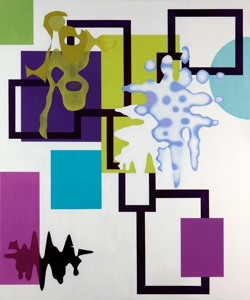
Enchanting Ennui, Shirley Kaneda, 2008, oil on linen
 
One experiment that I will try is embedding solid shapes into the wovan canvases made from strands of layered nylon. I want to try and tie them in/ weave the nylon through them from different angles to hold them in palce. The sloid shapes were inspired by the works of Shirley Kaneda where her oil paintings on linen play around with the layering up of solid line, abstract patterns and solid shapes.

Shirley Kaneda
Thunderous Silence, 2009
Oil on Linen
 
Linda Besemer:
 
Linda Besemer Fold #7: Optical Objectile 1998 acrylic on aluminum
 
 
I am very interested in the layer and build up of different coloured nylon strands. I want to use the frame as my support and build up different areas of thickness around the stirdy frame. I want to create an illusion that some areas are thicker and some thinner. The thicker areas will explore the layering of colours, and creating the ability for these strands to compact together to almost make a canvas background. The thinner areas will explore the delicacy fo the thin nylon strands and their individual colours amongs the space around them, they are elegantly floating in space, supported only by the tension of each one wrapped around the frame.


Tuesday, 18 September 2012

Interesting artist (different ways to install my work)

 - I think this artist is very interesting in an experimental sort of way. Recently I have been working on more elegant works and looking specifically at the delicate materials, nylon and PVA skins and how they support each other in  a very fragile relationship.

Apfelbaum's Feelies are similar to my previous works where they expire materiality and have a playfulness to them. In terms of their installation, it could be interesting approaching the experimental works and presenting them in a way that keeps them in that realm rather than hanging them on the wall as a true art typical art work.

Polly Apfelbaum, "Feely Feelies Feeley," 2010, various materials and sizes - Plasticine and non-drying clay.  "Not Extractions, but Abstractions, Part II" at Clifton Benevento 

Polly Apfelbaum / Nicole Cherubini: Installation View

Exhibition by Apfelbaum and Cherubini: http://www.likeyou.com/en/node/19134 


Tuesday, 11 September 2012

 Fragility:

In my most recent works I have really been influenced by the idea of fragility and I am exploring this idea in a number of aspects, such as materials, imager, installation and the viewer's interaction with the works.
  - looking at suspending the works and using the light to expose the texture and translucency of the PVA glue skins
 - The light makes it difficult to see the delicaqte images form some angles but after careful inspection the viewer can catch glimpses of a fragile flower..or other delicate imagery.
 - both the nylon and PVA glue take turns in acting as the support of each other - the platted nylon gains a heavier/stronger quality as a plat holding up the sheet of PVA glue but then the PVA holds the shape of the thin nylon strands in an embedded sheet of PVA glue.

  - In this work I am trying to explore the fragility of each material and see how they can support each other to create a work that can stand on its own. The strength of the plat is supporting the form of the PVA glue square and the PvA square is helping to keep the plat in this form. The two very fragile materials are supporting each other to kkep the form of the overall work.

Sunday, 9 September 2012

 Studio:

 - I plan to make these smaller PVA skins into canvases and have the nylon fall from the small surface in a long bunch of strands. I have become very interested in the fragility of these works and I feel that even though the PVA glue can support the large number of nylon strands there is a slight sense of weight and strain on the supporting surface.
 - I have been looking at the works of Leslie Schomp and her use of hair in embroidering self portraits and other images. In these works there is a hair like quality about the bundles of nylon hanging from the PVA surface.
http://likeabirdblog.com/2010/08/embroidery-art-3/

These works by Schomp have a strong sense of fragility in both the materials and the subject she is working with. I want to further explore the sense of fragility in my work through the materials, imagery, and installation of my works. (I am researching this idea more as I have decided to work with it in my curate and critique.)

     Leslile Schomp


Fragility

 - Materials - the support of PVA glues is very delicate and has a sense of temorality to it. I am working on a relationship between  PVA glue and nylon. I am trying to push a sense of fragility in these works. Even though nylon is a very delicate material, light, and fragile, the plat gives this material an almost heavy quailty against the soft, translucent sheet of PVA glue.
 - Imagery - I am working on creating a delicate form in the middle of thsese works with the nylon plats. I feel that the loose loops and casual forms create delicate images. I want to work on these images more and really create a sense of fragility. I may make larger plats to push the heavy quality of the nylon, a quality that nylon does not normally posess.
Colour - I feel that the lighter colours create a stonger sense of fragility in the nylon and form a softer image. Using brighter colours or darker colours may work well witht he larger plats to give them more weight against their fragile, delicate support.

Installation - There are a number of ways I could go about installing these so I will need to test them all out.
1) hanging - creating strands of nylon to help support the hanging images. The viewer will be able to walk around the images and get a strong sese of their fragile materials as they move in repsonse to the presence of the viewer. The viewer can experience the image from both sides as the PVA has a translucent quality. There are different levels of translucency across the image and I feel this will add to the fragility of the embedded image and will allow for light to access the images from both sides and highlight the detail and material qualities of the works.
2) pinned to the wall - allow for the viewer to impact on the fragility of the works. The images may be seen clearer against a wall. I feel that the plat works will work better on a wall as there is the strong permanant wall structure supporting the delicate pins holding up a fragile PVA glue skin with an image made form soft, light nylon that has been given a heavy quality against these other materials.
3) Canvases - Light MDF, popsicle sticks, framw made from embedded nylon.
I feel the frames could give the works an elegant appearanc ewhich I am more interested in after movign on from the images created in my final drawing assessment. I will trial these out to see if they work well with the idea of fragility.