Monday, 22 October 2012

Final Yr 2 Installation:


After continuing on with the ideas and material relationships from the year 2 drawing paper I have slowly developed my ideas and searched through a number of ideas to get to this point. I now can see that over the last semester I have apprached each material, and material relationship in an experimental way, but there is a logic and methodical approach to how I work with these materials that generate a desired outcome.
 
After working with cotton and PVA glue for a number of weeks I started to notice that I was more interested in the delicacy and elegance of the cotton and decided to step away from the PVA glue as this material held a kind of experimental/gluggy look to it that took away from the fragility of that fine single thread.
 
These final works are an exploration into my idea of multiple layers of somthing fragile appearing litterally, physically and metaphysically strong. The effect of layering fragile materials suggests ideas of strength and structure, whereas exposing that fragile material to the empty space shows its delicate nature and dependancy on its support.
 
In the four works to the right I have investigated this idea of constructing a structure from layering multiple fragile elements. These layers create interesting patterns referencing weaving, looking at optical illusions, tightly woven and delicately spaced out grids, diagonals, and different colour relationships between the lighter and darker threads. In these works the frame and image have become interrelated, the frame is both the image and the support.
 
I also decided to make a work directly on the wall to attempt to step away from the confines of the frame and related directly to the wall to become part of the work as the support. Making the viwer aware of the wall as the support can also lead them to inspect the environment I have intstalled my work in and notice the grid pattern in the window has influenced my pattern choices. Although I have not built this structre around a frame there is still a sense of confinement to the work as it is supported by pins in a neatly set out rectangle relating to the shape and structure of the other works.
 
I plan to continue working with this idea of multiple fragile elements accumulating to make a strong structure as there are a number of materials and material relationships that could bring about this idea in other ways.


Sunday, 21 October 2012

Setting out for final exhibition:

http://www.frieze.com/issue/review/ruth_laskey/  

An article about an artist named Ruth Laskey who had a growing dissatisfaction with the given materials of painting and so she started to paint into them with woven structures instead. – Grids, patterns, illuminated areas of blank linen

"The grid can be seen as ‘an image of the woven infrastructure of the canvas"

My most recent works – layering and repetition of the fragile cotton threads has reference to weaving and may also refer to the structure of a canvas created over a frame – confined to that support. My final wall work that I made for the exhibition is an exploration away from the canvas/frame and more about the layering and structure of a number strands of something fragile and easily missed as an individual to appear strong and rigid once presented in a layered structure. From afar the defined grid structure gives the cotton thread a strong appearance that if the viewer was to see an individual strand. Up close the viewer can inspect the work and notice how delicately it has been constructed around each pin, the material acting as both the image and support but with a stronger relationship to the wall as a support aswell. This work was made to be site specific , refernceing the grid structure found in the window, as I have experienced the space and taken aspects from  the environment that interest me.


Untitled, pins, cotton thread


Understanding if an image is successful or not:
 
In a previous post I noted that a lecturer told me to try and transfer some of my drawing images simply to paper to see if they would generate successful images on their own. These three works are some example of the experimental works I made in my PVA glue and material installation. I picked images that read as more elegant compositions as I found I have been more interested in the neatly constructed images of pattern and the simple colours. I wanted these works to resemble similar textures to the materials I used in my past drawing installation but done straight onto paper. I feel that these three works came out successful and immitated the materials successfully. From this point I have made more of an exploration into the fragility of cotton thread and the structure and strength that can be created through the layering of individual strands.
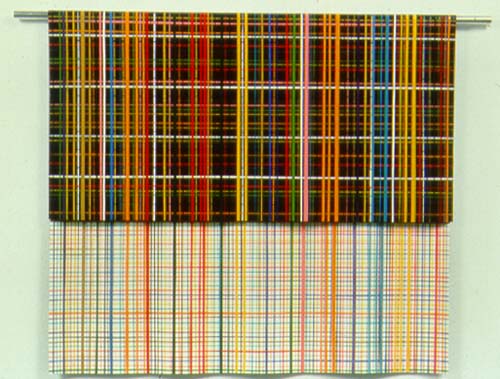


Untitled, ink pen on paper

Untitled, ink pen on paper

Untitled, ink pen, pastel on paper
 

Tuesday, 16 October 2012

 
My end of year exhibition space:


  • After seeing my exhibition space I am very happy with my positioning as the light will enhance the beauty and fragility of each work. I am interested to see if the cotton thread casts shadows on the walls.
  • In my art practise I have also been interested in responding to the patterns found in the space and the surrounding structure, so being next to a gridded structure and neighbouring buildings gives me a chance to show these references and relationships of everyday patterns, mixed with patterns from memory and past experience.
  • I have been positioned next to jenny who works in a similar way to me. We are both interested in similar colours, some repetition and gesture, and presenting a number of works. We plan to install our works together to see if there is an interesting relationship we can create between our works, but we don't wan tthat to be a focus.
I

Saturday, 13 October 2012

Most recent works: Developing a series of works where I am exploring the relationship between the cotton thread and its support to create a structure using line and grids. (all works are yet to be titled)

Through the accumulation of multiple layers of something fragile emerges a structure that is literally, physically and metaphysically strong. My art practise is an exploration of materials through the playful use of repetition, line and grids. Playing with the potential of simple materials to expose their natural characteristics and discovering methods that brings about interesting material relationships that appear in my process evident works. The use of line and grids has an underlying reference to weaving. I do not wish to focus on the delicate history of female craft, but rather generate conversation about my playful interaction and manipulation of these simple materials.

  l Working with intuition     

  l   Keeping the works fresh

  l   My most recent works have explore this relationship between cotton thread (a fragile material) and the sturdy frames.

  l   Considering all aspects of the work – in their rawness they all add to the conversation and talk about materiality, support and structure

l   Most recent works – delicate, elegant, through the repetitive process and accumulative gestures there is an exploration into the idea of a structure created by the gathering of individual fragile things in this case strands of thin cotton thread.

l   Thicker areas and layering – allude to the idea of strength, create textural difference and patterns

l   The more exposed strands of cotton will appear fragile, elegantly floating in space supported only by the tension of each one wrapped around the supporting frame.

l   Being true to materials – “Materials need to be accepted as they are and used simply by artists to explore their strengths and generate conversation and understanding around their materiality and the ability of that material.”...from past blog post Wed. 25th July


Wednesday, 10 October 2012

Continuing to talk about Deborah Crowe:

 - I find that the materials she uses are very interesting but as I read about her more in depth I have noticed that I appraoch my art practise in a similar way to her:

This is a blog page I found that talks a little bit more about her combination of ideas and how they work together: What is Deborah Crowe's 'one idea' made up from and how does it keep recycling in various works?

http://bvacontexual.blogspot.co.nz/2010/09/deborah-crowe-texitle-and-art.html

Points that I found interesting to me and are similar to the way I see my art practise:

  1. "She explains that she has great fascination in the sense of being restrained and contained within a space, she plays with the idea of discipline and boundaries in her works, like she said 'i like to see where the edge happens." I am interested in this idea of discipline and boundaries in a work. I feel that there has been a sense of this throughout my art practise, whether the materials are limited by their abilities and their relationships to other materials , or byt he surface that is supporting the work. For example my most current works explore a close intimate relationship between the frame (support) and the cotton thread, I will try to chellange these boundaries.
  2. "There's no definite idea for Deborah's practices, her works consists many ideas that constantly shifts. However there are some focal elements that i picked out from her slides of works. Some of the main ideas are based around containment, weaving, bridge froms and wolven like architectures. Even she admits that 'documentation of some work become the material for the next to come'." I feel that this is very similar to my art practise. My work thorughout the year has changed a lot and wondered down different paths, but it continues to reference a number of ideas and my underlying interests such as pattern, colour, grids, repetition, truth to materials, and working with a visual process.
Another blog:
 
Interesting points:
 
  1. From listening to Crowe's story about being locked in a cupboard by her sister, and actually liking the feeling of being contained, I can see through her pieces of work that Crowe is obviously influenced by her surroundings and her experience of space.
  2. Crowe's wide range of interdisciplinary works have quite a few recurring themes throughout them. Some of these themes are about the containment of the body, perceptions and experiences, real or implied space, control, documentation, imagined spaces and construction (textile, woven, architectural) to name a few. In particular it is evident that Crowe is interested in the use of repetition and gridding in her works.
  3. Even though fashion seems completely opposite to her construction and architectural works it all made sense to me when Crowe said, "Just as fabric contains the body, so does architecture, just on a different scale..." This shows the relationship that between fabric and architecture. The interwoven qualities are the same with fabric as with building construction. 
  4. Overall, I think the 'One idea', or basic gist of Crowe's work is an investigation into how we interpret space and containment. We can see this throughout her works and while some of her works are designed to contain the body, others are about intervening with and controlling space.


Tuesday, 9 October 2012


Deborah Crowe
Installation
2003
..
Warp #1 2003
Nylon, Acrylic and Stainless Steel
500 x 500 mm

Warp #2 2003
Nylon, Acrylic and Stainless Steel
500 x 500 mm


                                          Deborah Crowe Warp #6 2004. Nylon and Acrylic


I am well aware now that the end of the year is very close and that a final work/works need to be made. I need to ensure that this does not restrict my imagination and my experimentation with the works and materials I am using. Today I found myself thinking too closely about the final presentation that I started to drift away from the acutal images I need to make and how each one will contribute to the conversation and ideas that I am working with.
After this mornings critique we discussed the impartance of the frame in my works as it plays a very dominant role in each work. I also found that I was a little worried about the installation and whether the viewer will be able to see my experimental side/ use of intuition and repetition and patterns. We discussed that it was important for me not to restrict myself and to keep it 'fresh.' I need to explore these materials and different aproaches to how the cotton can respond to the fram, or even become the frame.
I am now interested in creating a very exploritory series of works that looks at the materials and their relationsip to one another. I want maybe make one very intimate, delicate, pristine and beautiful, one which explores the optical side and the layering of frames, one which is directly onto the wall, supported by pins or a frame of cotton, one which may be propped out from the wall to ensure that the viewer can see the bautiful colour stips from the side and how the insensity of the grids can give a bold colour striped effect from a side on view.
I will continue to work on these works individually and pay lots of attention to making each one as intimately and interesting as I can to allow them to speak for themselves and generate interesting conversation as the viewer delvelops a colse relationship to each individual work and the different quality that they each bring to the series.

Deborah Crowe:
http://bonniematildapryce.blogspot.co.nz/2010/09/deborah-crowe-13092010.html

Crowe's wide range of interdisciplinary works have quite a few recurring themes throughout them.  Some of these themes are about the containment of the body, perceptions and experiences, real or implied space, control, documentation, imagined spaces and construction (textile, woven, architectural) to name a few.  In particular it is evident that Crowe is interested in the use of repetition and gridding in her works.
Deborah Crowe, glass with colored cotton


Sunday, 7 October 2012

Experimenting with presentation/ installation

                                     Web Samplers and Bahee Clock Village, Installation view, 2001

http://www.1301pe.com/exhibitions/images.asp?EID=75&img=Pae_White_02.jpg&url=Pae_White_02

Frieze Magazine: Pae White by Dale McFarland: http://www.frieze.com/issue/review/pae_white/

Summer Sampler is a collection of spider webs, each one sprayed with paint and mounted separately on a different coloured card. More obviously figurative than the other pieces in the show, these framed images are scattered randomly over one of the gallery walls like delicate souvenirs of past summers. The pastel shades and glitter give the collection a childlike charisma reminiscent of primary school handicrafts; making pictures with macaroni or taking a pencil for a walk. Spiders webs are literally ‘homespun’, beautiful, useful and almost invisible, they could be metaphors for domestic production, small scale and personal.

Pae White is one of the artists that I was included in my Curate and Critique this year. I fell in love with these delicate works which brings the beautiful 'homespun' spiders webs from nature in to contact with her hand made colorful backgrounds in an interesting collision, focusing on their almost invisible presence. 
I like how these works are both beautiful, handcrafted, delicate, elegant and yet they also have an experimental vibe which springs from their color, size variation and the way that White has installed them scattered randomly over the gallery wall. 

This way of installing my works may work well with my interest in being experimental with my making process and trying to create relationships and comparisons between works. I have become more interested in the delicacy and handcraftedness of each individual work but at the same time each work is an experiment of image making, gesture, line, layering and color and I feel that this type of installation may bring out the experimental, intuitive side of each work and who they all converse with each other and the viewer. 


Thursday, 4 October 2012

Tester works (for nylon and frames)


  Ideas I am pushing and working with

 - Line, grids - have that reference to weaving and the nylon rplacing the canvas.
 - layering (push and pull, backgroudn and forground)
 - colour - colours that stand out and lightercolours that are subtle and draw the viewer in.
 - materiality - simply looking at the tension created in the fragile lines of bnylon pulled aorud the frame

 In order to focus on the elegance and beauty of these fine colourful lines nylon I feel that the white frames work best as they blend into the wall. I also want to experiment with the intensity of the layering (almost creating a canvas support out of nylon). I want to make some frames that don't have the the outer ridge so that the viewer can focus on the tension of the nylon..or I may leave them as they create and interesting gap betweent he frame and the nylon and create a subtle shadow across the frame.
 
 Yr 2 Show


The year two show was held in a church on Khyber Pass and included approximately 15 yr 2 students from painting, photography and sculpture.
I was only able to set up and attend opening night which was very successful. I found that even though we had a very short space of time to put this exhibition together we all compromised with each other and discussed spots for our work. Each student brought their own wirk and ideas into the space and I found that it tied the space together as some responded tot he space and others works complimented each other.
For me I was interested in creating very delicate installations that appeared fragile and subtle. I then wanted to introduce an unexpected element witht he intense vibrant neon yellow circle to work against that subtlty.
Near the entrance I hung a work from my 'Captured' series in between the two doors. I found that it had a subtle relation to Devon's video works based around the beauty of nature. I also chose to hang this work as I found the leaves brought in the wood from the walls and floor of the beautiful church. This installation hung delicately and blew in the presence of any breeze. Josie also placed her quiet breathing installation beneath my work which I felt enhnced the delicacy of the work as it moved.

I placed my work with rainbow strands of nylon embedded in the glue sheet in the frame of a side door. I found that hanging it from the nylon strands would emphasise the fragility of the installation and have it suspended inforund of the wall to see the semi translucency of the PVA glue.

I am now interested in moving onto more elegant works, still focusing on nylon but taking it away form the experimental/gluggyness of the PVA glue and bringing out the beautiful tension created between layers of nylon.


"Captured" (one form a series of 3)


Wednesday, 3 October 2012

New artist and ideas:

This is a rough idea of one of my new ideas to have nylon strands glued to a linen canvas. I want to work with the grid and elemnts of the weaving (which will relate back to the linen which supports the imagery). I will try this with PVA glue and nylon on a linen canvas, building up different layers, textures, colours and patterns of nylon.

Helene Appel:

Chopping Board - Chopping Board Oil on canvas 30x45 cm
 
Helene Appel, “Netz,” 2010. Acryl, oil, aquarell on canvas 192 x 365 cm
 
Helene Appel, Leek, oil on linen, 72cm x 118cm, 2009
 
Similarly, Helene Appel is not interested in regarding an object as mere training ground for a painter’s technical capabilities. Although Appel is clearly capable, she is mainly dedicated to painting the object in front of her. The raw linen becomes the background. It has to suffice since what matters is the dissected leek. Everything else would be too much and distracting so she decides to loose herself in the object instead of the paint she applies. It is mark-making nonetheless, but with a higher degree of control.
 
Like Helene I am more interested in the nylon patterns I want to creat on the linen surface. Even though th3e weaving and grids referenc the make up of the support I want to get lost in the patterns, colour combinantions and merging of colours created through my pattern making.
 
In the enxt two weeks I am going to really explore these two paths, nylon on linen backgorunds and nylon simply supported by a frame. I feel that both these options escape the experimental qualities of the gloopy PVA glue and focus more on the delicacy and elegance of the patterns made from thin strand sof coloured nylon.
Next plans / new interesting and inspiring artists:

Next plans:

I am now trying to prgress towards making my works even more elegant. I feel that the PVA glue was holding the works back in this department and adding an experimantal feeling with a gluggy/heavy quailty.
I want to use similar patterns of weaving and grids, laying the nylon strands in different intensities to build up colour and highlight the areas that I leave empty.
For these works I will glue nylon strands around plain frames to focus on the delicacy of the thin nylon strand sfloating in space.


Artists that have inspired me:

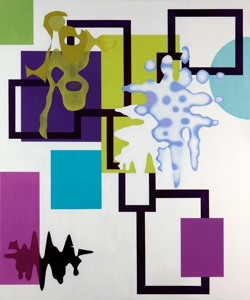
Enchanting Ennui, Shirley Kaneda, 2008, oil on linen
 
One experiment that I will try is embedding solid shapes into the wovan canvases made from strands of layered nylon. I want to try and tie them in/ weave the nylon through them from different angles to hold them in palce. The sloid shapes were inspired by the works of Shirley Kaneda where her oil paintings on linen play around with the layering up of solid line, abstract patterns and solid shapes.

Shirley Kaneda
Thunderous Silence, 2009
Oil on Linen
 
Linda Besemer:
 
Linda Besemer Fold #7: Optical Objectile 1998 acrylic on aluminum
 
 
I am very interested in the layer and build up of different coloured nylon strands. I want to use the frame as my support and build up different areas of thickness around the stirdy frame. I want to create an illusion that some areas are thicker and some thinner. The thicker areas will explore the layering of colours, and creating the ability for these strands to compact together to almost make a canvas background. The thinner areas will explore the delicacy fo the thin nylon strands and their individual colours amongs the space around them, they are elegantly floating in space, supported only by the tension of each one wrapped around the frame.