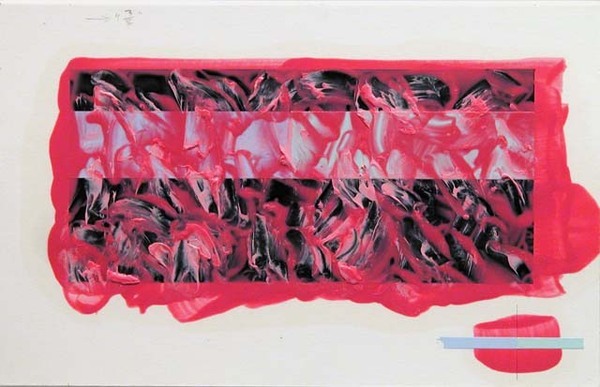
Thursday, 30 August 2012

Studio Work: (My drawing has now merged with my studio work and I am continuing to develop on from the final drawing installation)

Over the last week I have discussed the next possible steps for the direction my studio practice practice with both Simon and Mon J.

Mon J has encouraged me to reaearch futher into Abstract Expressionism and develop an understanding of my on attitude towards abstraction.
She has also helped me realise that there are currently a number of different aesthetic conversations/ moods occuring in my work - childish, playful and almost messy works, and then there are others which are cartooney and others more elegant and meticuously made.

I feel that for my final drawing installation this almost confusion mood and aesthetic attitude of my works fueled the playful conversation I wanted to create.
Now that I feel I have portrayed that idea successfully I am intersted in trialling different routes and focusing more on creating eligant works or going towards the playful, cartooney images.


Eligant works:

In order to find which individual works from my current drawing installation are successful in their crudness Mon J suggested I transfer some images I felt would work on their own onto a flat surface (cartidge paper). I have found inky blue and red pens to try and immitate the nylon on paper and I plan to use thick chalk, oil sticks and tubes of paint to work beside these fine lines and over the top to portray the denser lines made from wool.
I am interested to see if the images will look successful given more space around the gestural marks and the careful and gentle attention I give to them will give them a delicate, eligant feel.

I have also started making some PVA glue and nylon works, with lighter more eligant patterns - mostly grids. I am keen to try and stretch the PVA glue around a frame as a more elegant, conventional approach to using these materials.

Possible artists: (thinking about some for Curate and Critique)

 18th Street Arts Center presents “Kaleidoscopic Gaze,” a painting and sculptural installation by L.A.-based artists Christine Morla and Eric J. Smail
 
L.A. Flippers", Installation View, Christine Morla
Woven found paper on painted gallery wall
Rimjaus Gallery, Mexico City, Mexico
2006
http://www.christinemorla.com/Art_Drawings12/Drawings12_02.html. - for more drawings

Judy Pfaff:


Elizabeth Murray:


Mary Heilmann:
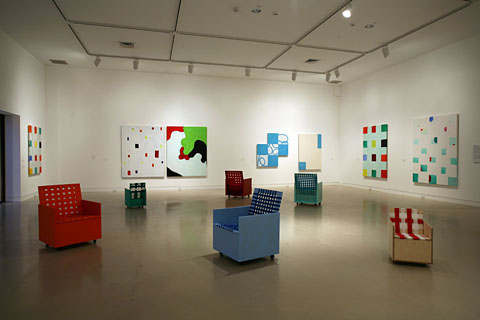
Sean Scully's wood cuts ( inspired my framed PVA and nylon works - more elegant and simple)
 

Tuesday, 21 August 2012

Final Drawing Installation!

After completing each individual work I pinned them all up on the wall and spent a lot of time moving them around to create a lively experimental vibe, and generate conversation surrounding materiality, the interaction between materials and the relationship that each individual work has to the works around it.

When I first pinned them up none fo the images were touching each other or over lapping. This gave each work space but I found that not matter how much space I tried to give them they were all fighting individually for attention in their own way. I have decidied to go along with this level of visual compititon between the works and force them to interact and chellange each other. Overlapping the images has sparked a new level of competition for dominance and has brought in ideas of clustering and allowed each work to relate closely to one another and feed off of each others visual components.


     The individual works are colliding with one another on a neutral white surface and ech one is fighting for the eye of the viewer.

I have placed some images with similarities next to each other to draw the viewers attention to each work.

I have also found that the materiality of the PVA gluie is highlighted more when I layer certain works over each other.

 The viewer can see through one work to the next in some cases and in others the front work takes over the other.

I feel these works work well as an installation and I am interested in the strong relationship between PVA glue, nylon, wool and paint. I feel that this installation successfully portrays my ideas and interests and generates a very lively, experimental and playful converation between works for the viewers to become a part of and interpret in their own way.


 These are some more recent additions to my installation of works. I feel that after spending time on this group of experimental image they are starting to build a strong conversation between themselves surrounding the elements of form, colour, and material.


I am consciously responding to previos works that I have made and really tring to push the relationship between each material and how they interact with one another both instantly and over time as they are hung on the wall..intense ares of wool


Monday, 20 August 2012

Looking back over some readings I found when I was first told about Jonathan Lasker:

Jonathan Lasker, written by Jonathan Lasker and Shirley Kaneda
http://www.jstor.org.ezproxy.aut.ac.nz/stable/40424009?seq+3&

1) This first article I found particularly helpful when thinking about composing my images and allowing each element, figure, color, ground, materials to take on different characteristics and say different things. In each individual work I can allow certain elements to dominate and together each material I work with in the image will bring it together to form a work I feel is complete.
A lot of the time it is hard to decide when a work is truly finished and whether it is successful or not. On page two of this article Lasker talks about an an intuitive feeling he uses to decide whether his works make the cut, or are finished. "It's pretty intuitive. Basically a painting's finished when it works as far as I'm concerned. It has to say something to me that I feel is effective. I'm trying to say certain things with the paintings and if the painting seems to communicate that thinking, then I feel it's been successful."
( I am interested in making sure that my work generates conversation about materials and the way they interact with each other. I also want them them to balance each other out visually when composed all together on my wall. I want to create lively conversation that has an essence of experimentation and playfulness, and I would like the overall composition to overwhelm the viewer with playful conversation between each work, and then for the viewer to inspect the works closer to see how I have exposed the characteristics of each material and their relationship to one another.)

2) Anther point that struck me was one page one, talking about different levels of drawing value. "The earlier paintings were less linear than the current. This show dealt with automatic drawing and subconscious imagery through using the format of scribble and different levels of drawing values"
(the value of conscious, planned, constructed imagery compared to unconscious, playful, experimental doodling/uncontrolled gestural marks with nylon and paint.)


 3) I am interested in the idea of being conscious of the unconscious....I am consciously choosing to generate images through my experimental/playful side. I am drawing on ideas, patterns, objects that I am familiar with in the everyday and constructing visual compositions that I intend to host a conversation about the interaction of materials including nylon, wool, and paint, on the supporting surface of PVA glue.
"I believe in the marks that I make. Yet, at the same time, I think I have a distanced relationship to myself as I am laying down makes. It's a case of the subconscious becoming conscious of itself."
When creating my works there is a constant shift between being conscious and unconscious. I like to be experimental and consciously respond to works I have previously made to ensure an interesting and playful dialogue develops between he odd of work that I am creating.

Saturday, 18 August 2012

                                                          
 This is a progress photo of a body of works I have been working on for my final drawing assessment. I am interested in taking an experimental approach to each work and playing around with the realtionship between my chosen materials, PVA glue, nylon, paint and wool. I am really trying to test their relationship to one another by embedding materials, layering wool and working gesturally with paint into the PVA glue.
I am interested to see how the randomly spread out shapes of PVA glue will hold up and respond to the materials layed down over them and embedded in them.
After some experimentation I have noticed that the more intensly layered areas of PVA glue are responding to the shapes I have created  with the materials and tend to give way to the materials and bend and curl in different ways.
I also want to think closely about the gestural marks and patterns that I am making and generate experimantal works that respond to onw another and allow a conversation to devlop amongst them when they are all placed on the wall. I am planning to re arrange them on the wall, possibly sprawled across one wall and arranged so that there are links between the works in terms of shape, colour, marks, and materials. Some relationships may be strange and some may not have much in common which will force the viewer to explore the wall and search for their own links and find possible commonalities.


Thursday, 16 August 2012

Timothy Taylor Gallery: Jonathan Lasker
http://www.timothytaylorgallery.com/artists/home/jonathan-lasker

" … In Lasker’s work, images … are part of a larger schema, but independent in terms of form, colour, texture, and manner of paint application. Each image becomes a thing itself, an element to be examined, experienced and categorized; a component of the larger grammatical structure that Lasker has built.” – Richard Kalina


http://www.timothytaylorgallery.com/exhibitions/jonathan-lasker-coloured-scribbles/

 - Jonathan Lasker: Coloured Scribbles28 FEBRUARY - 27 MARCH 2004

All these paintings begin as a set of postcard size drawings in which Lasker experiments with the placement of shapes and colours. When one drawing is finally selected, the large painting on canvas faithfully magnifies and replicates the drawing, allowing for surprising shifts in scale and mark-making.
(This could be another approach to creating works. Currently I am making each work one by one and allowing my experimental side to do the work. There isn't really a strict sense of planning in my method of producing works, but more of a response to each work  I have previously made and creating relationships between them, in terms of shape color, and gestures.)
There is always extreme contrast in Lasker’s paintings. Giant primary-coloured brush-strokes, loaded with gooey paint, fight against flat, dry, linear grids with the complexity and clarity of computer graphics. None of the thick splurges of paint attempt expression, instead each stroke exalts handmade, technical virtuosity that can approximate machine-made precision.
(I am interested in meticulously constructing images which are experimental and play with a range of textures, such as thick and thin string, and different gestural brush strokes that have a sense of experimentation and some control, repetition and link back to the movement of the hand. )

Monday, 13 August 2012

Thinking about presenting my works, and "Curate and Critique"

Helen Calder, Installation view, 2009

                            Jonathan Lasker, Cheim and Read Gallery, March 29 - May 5, 2007
                                         David Reed, Peter Blum Gallery, February 5th, 2010
Recently I have been looking at artists who I am considering putting my works in an exhibition with for "Curate andCritique." One aspect that is very difficult to decide on is the space to create this exhibition in and where to locate the space.

After looking at some past exhibitions by these artists, and reading the reviews of these exhibitions I have found that their work is well read in a simple gallery space, which is well lit and open so that the wokrs can bounce off each other and relationships and conversations between works can be formed.
I want to ensure that the space and location of the space that I choose enhance my works and their relationship to the other artists I choose. At thsi moment my gut feeling hints towards keeping it simple, and allowing the works to speak for itself, of its materials and experimental yet meticuously constructed imagery.


Research on Jonathan Lasker at Timothy Taylor Gallery:

http://www.timothytaylorgallery.com/exhibitions/jonathan-lasker-sean-scully-miquel-barcelo-guillermo-kuitca-jiri-georg/
 - Jonathan Lasker (b 1948)
“World of Mutual Exclusion” 1989, oil on canvas, 96 × 132 in (243.84 × 335.28 cm)
Lasker’s distinctive style and extravagant use of colour has made him one of the most recognised artists of his generation. His paintings appear initially, and deceptively, to be open, simplistic and an unstructured mixture of form, line, tone and colour. A closer look reveals that Lasker’s works are meticulously constructed, with every line being foreseen, organised and planned. “Nothing happens in my pictures without reason. There are no arbitrary marks…”

After creating a number of smaller experiemntal works I have realsied a number of similarities in my art practise to that of Jonathan Lasker. Even though each work seems experiemental and may have a sense of casual doodling, when looking at each work and then viewing them as a group it takes time to realise the meticlously constructed images and patterns. One idea of Lasker's that has influenced my most recent works is the idea of using doodling and image making to fill up space. I have drawn on pattern from memeory and used these lines to create layered images where the pattern is thought through and constructed so that it fits together and looks effective.

Sunday, 12 August 2012

David Reed, Color Study. May 7th, 2012


Judy Millar, Untitled, 2002

                                             Judy Millar, 2009

                                             Untitled, 2009

                                             oil and acrylic on aluminium, 510 x 790 mm

Reed and Millar are two artists that I am becoming more and more interested in as I have started producing some very experimental and gestural works. I enjoy how my works have become random and unpredictable for both me as the artist when I make each one and for the viewer who gets to experience something new with each work and spot links and similarities of their own.
I also find it interesting how I can see certain gestures emerge in a number of my small experimental like works. I like to allow my creativity to take over and create new images influenced by both my surroundings and following my natural instinct which has been built around past experiences and memories.
I like how Reed and Millar's works have an experimental element to them and how their works don't feel too controlled and are simply showing the artists working with their chosen materials and working with the strengths of those materials to expose them in their simple form.
I am intetrested in possibly including these artists (maybe just Richard Reed) in my next assignment "Curate and Critique," along with Jonathan Lasker, Katherine Day's video of plastic hanging form a washing line, and maybe other artists shuch as Helen Calder whio are material based artists.


Thursday, 9 August 2012

Drawing:
Untitled (51cm x 23cm)
PVA glue, Nylon

 I have done a series of small detailed works focusing on intimate time consuming gestures made with nylon in small areas of PVA glue. At this point I have decided to genearat pattern through my past experience of doodling and known gestures inspired by my surroundings. Jonathan Lasker was suggested to me as an aritst and
I find his approach to generating gestures very interesting and similar to how I wan to approach my works, lookoing closely at consciously being unconscious and doodling/ gestue making to fill up space.
Untitled (30cm x 47cm)
PVA glue, nylon

Untitled (17cm x 21cm)
PVA glue, nylon

Untitled (18cm x 18cm)
PVA glue, nylon
Untitled (16cm x 20cm)
PVA glue, nylon


 Painting:

These are some progress photos of my fluro paint and PVA glue skin. I am trialling different coloured paints eg. normal, fluro, and black and white to see which one I feel has the most imapct on the viewer and supports the materiality of the skins.
These works have been influenced heavily by Helen Calder's paint skins and how she is trying to expose the material qualities of the paint skins in relation to gravity and time. I am interested to   continue experimenting with these skins and how to present them in a way that will expose their materiality in a simple way.


Another decision that I want to make is whether to present the glossy side or the matt side.


Untitled (25.5cm x 24cm)
PVA glue, fluro paint, copper wire


     Untitled (32cm x 44cm)
     PVA glue, fluro paint, copper wire


 Untitled (25cm x 25.5 cm)
 PVA glue, fluro paint, copper wire


Painting:

In my painting I have been working with paint skins of PVA glue and fluro paint. One idea was to make the skins into more of an object and show their flexibility using copper wire to mold them into a shape agans the wall. After atempting to do this In found that the copper wire was distracting to the true materiality of the paint and I felt that the copper wire over did it. I want to continue making paint skins as I am ver interested in their materiailty but I want to focus on being true to the materials and try presenting and exposing them in their simplest forms as to get a true sense of their characterisitics and strenghts.

Wednesday, 8 August 2012

Drawing:

After a meeting with Simon about my drawing practice I did some further research on an artist he mentioned named Jonathan Lasker. I am very interesting in the patterns and images that I am making to work over my chosen materials PVA glue and nylon.

Jonathan Lasker: Hidden Identity, oil on linen, 40.6 x 30.5cm, 2009


Good website on Jonathan Lasker:
http://www.speronewestwater.com/cgi-bin/iowa/artists/record.html?record=5

Essay: Jonathan Lasker: the dialectics of touch
http://www.speronewestwater.com/cgi-bin/iowa/articles/record.html?record=135

Quotes form this essay that I think will help me with my image making and where I may find inspiration for my image making. I am still unsure if I want to go by the process of looking at doodling or create images/doodles that reference objects, my surroundings, or things I am interested in.

"According to Lasker, this doodling creates 'a cat;s cradle of black lines, a little like knitting that's come unstitched'. 'It comes from the sketches which I make and from which the paintings are copied more or less verbatim. It's like frenetic drawing, subconscious doodling. I use it as a space-filler...I reference the subconscious doodling. I use it as a space-filler---I reference the subconscious in a very conscious way. I take something from the subconscious and reprocess it. I go from direct subconscious mark-making to graphic reproduction."

"Doodling is pleasurable: we do it in secret, for our indulgence. It is irresponsible, not loaded with spiritual or psychological expectations, unless we claim we are exercising the unconscious."


http://vimeo.com/2802249 - This is a youtube video of Lasker talking about his practice (most interesting after the first 2mins)